

H-1B Specialty Occupation: The Degree Isn't the Job
What makes a job a specialty occupation?
I get this question more than almost any other in H-1B work: what makes a job a specialty occupation? It is not the job title, and it is not whether the person holding the job is smart or well qualified. It is whether the position itself, as the employer actually defines it, requires theoretical and practical application of a body of highly specialized knowledge — and a bachelor's degree or higher in a directly related specific specialty, or its equivalent, as the minimum for entry into the job.
That distinction matters, because USCIS looks at the job first and the person second. A brilliant engineer in a job that any capable graduate could fill is not a specialty occupation case. A well-defined engineering job that genuinely requires that training is, even if the title sounds ordinary.
So how does USCIS test it? The regulation gives four ways to show a position qualifies, and the employer has to establish at least one: a degree in a directly related specific specialty is normally the minimum requirement for the particular position; that degree requirement is common to the industry for parallel positions at similar organizations; the employer normally requires it for the position; or the position's duties are so specialized, complex, or unique that the knowledge needed to do them is normally associated with that degree. "Normally" means the usual, typical pattern — not always, but the regular standard.
Notice what is not on that list: a wish, a preference, or a habit of hiring people with degrees. "We like to hire graduates" is not the same as "this job requires a graduate." The job description, the duties, and the employer's actual hiring history have to line up.
Why the duties matter
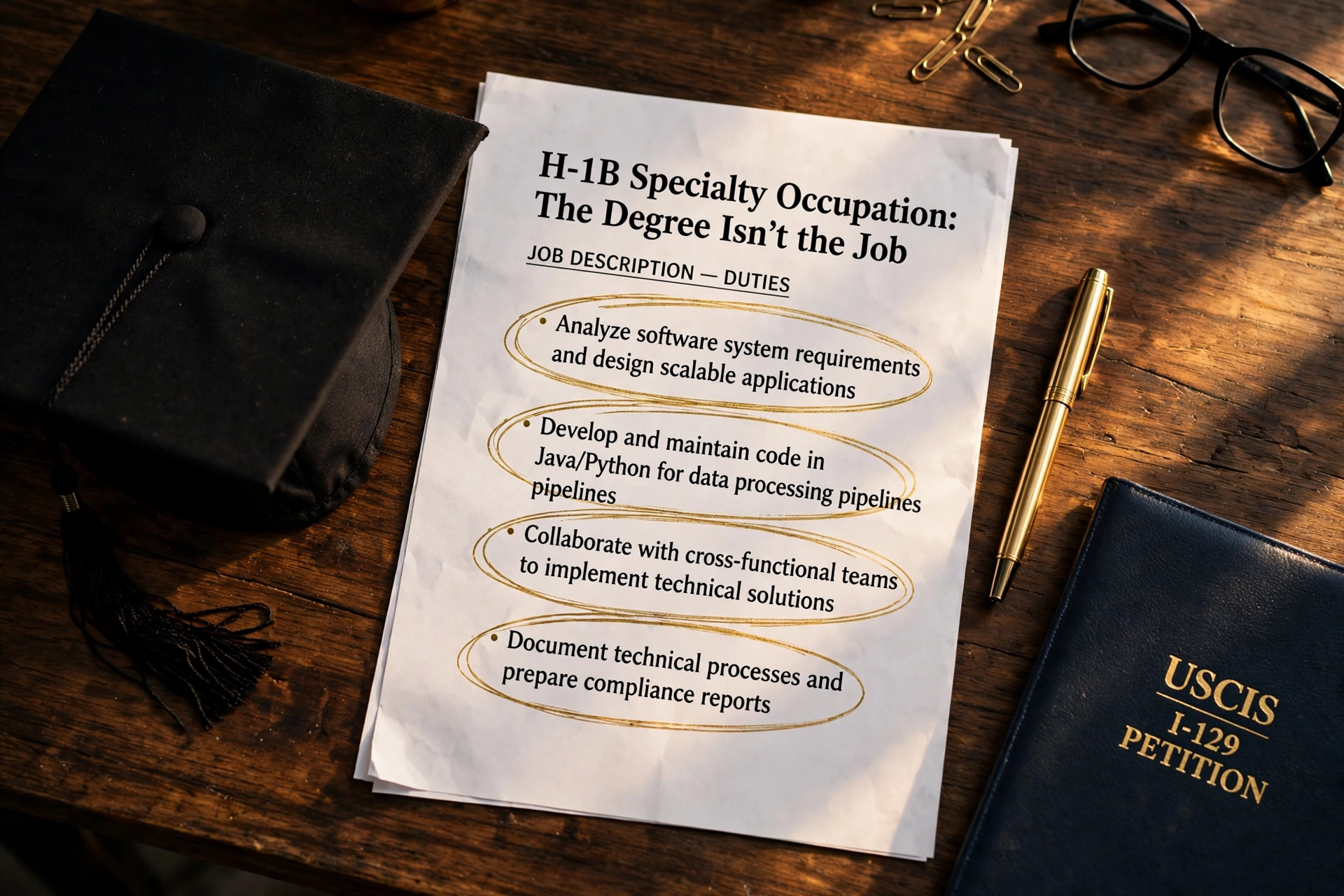
The duties are where most cases are won or lost. A list of vague tasks — "will work on projects, will help the team, will use technical skills" — tells USCIS nothing. Specific duties do: what systems, what tools, what decisions, what level of judgment, and why that work cannot be done without the specialized training. If the duties read like a generalist job, USCIS will treat it like one.
How degree fields fit
The degree field matters too, and this is where the rule is often stated too loosely. The degree does not have to carry one exact label, but it does have to be directly related to the job's duties — there must be a logical connection between the degree and the work. A position may allow a range of qualifying degree fields, as long as each one is directly related to the duties. What will not work is a general degree requirement with no direct relationship to the job: if attainment of a general degree, without further specialization, is enough to qualify someone for the position, the position is not a specialty occupation. A computer science degree for a software engineering job fits. A general business degree for a highly technical engineering job, with no explanation of the connection, does not. Where experience substitutes for a degree, that equivalence has to be documented carefully — it is not a shortcut, and it is not assumed.
What selection does — and doesn't — mean
Registration and selection are a separate step, and they come first for cap-subject cases. Selection is no longer a straight lottery: under the wage-level-weighted selection rule, a registration is entered in the selection pool once for a Level I wage, twice for Level II, three times for Level III, and four times for Level IV. A higher wage improves the odds; it does not guarantee selection. And selection decides nothing about whether the job is a specialty occupation. That question is evaluated on the petition itself, on the evidence about the position — not on the job title, and not on the beneficiary's qualifications alone.
If you are an employer, the practical advice is simple: define the job honestly, write the duties the way the job actually works, and require only what the job truly requires — but require all of it, and be ready to prove it. If you are a beneficiary, ask to see the job description before the petition is filed. You should know what USCIS will be asked to believe about your job, because that description is the case.
Tell me what you are working on and I will reply in writing, focusing on the issues involved.
General information, not legal advice. Requirements and processing change; we confirm current rules for your case.
If a job offer is on the table and the degree fit is the question, request a written evaluation before the petition is framed.